Weevil News |
No. 34 |
4 pp. |
15th June 2006 |
ISSN 1615-3472 |
|
Munteanu, C.L. & L.A. Teodor (2006): CURCULIO-Institute on mission in Provence! Report on the 4th International Meeting of the CURCULIO-Institute in Cotignac, South France, from 16th to 23rd April 2006. - Weevil News: http://www.curci.de/Inhalt.html, No. 34: 4 pp., CURCULIO-Institute: Mönchengladbach. (ISSN 1615-3472). |
|||||
CURCULIO-Institute on mission in Provence!
Report on the 4th International Meeting of the CURCULIO-Institute in Cotignac, South France, from 16th to 23rd April 2006
by
C. L. Munteanu, Bucharest
&
L. A. Teodor, Cluj-Napoca
(with 25 photos and 2 scroll pictures)
Beautiful and interesting places
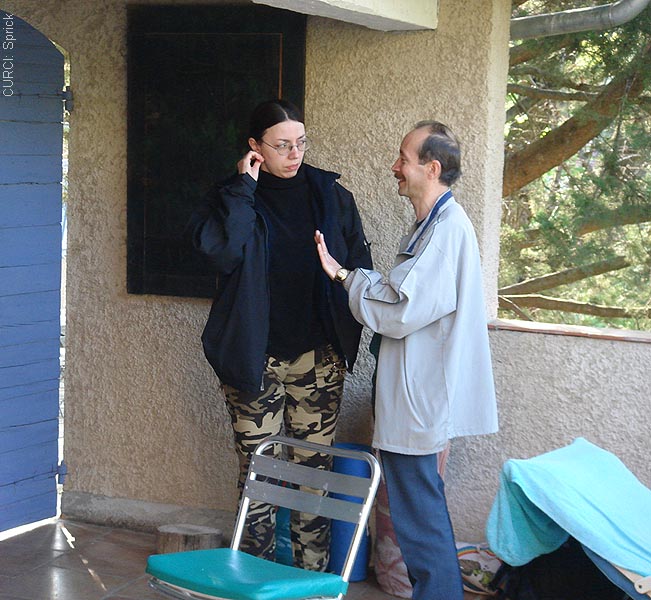
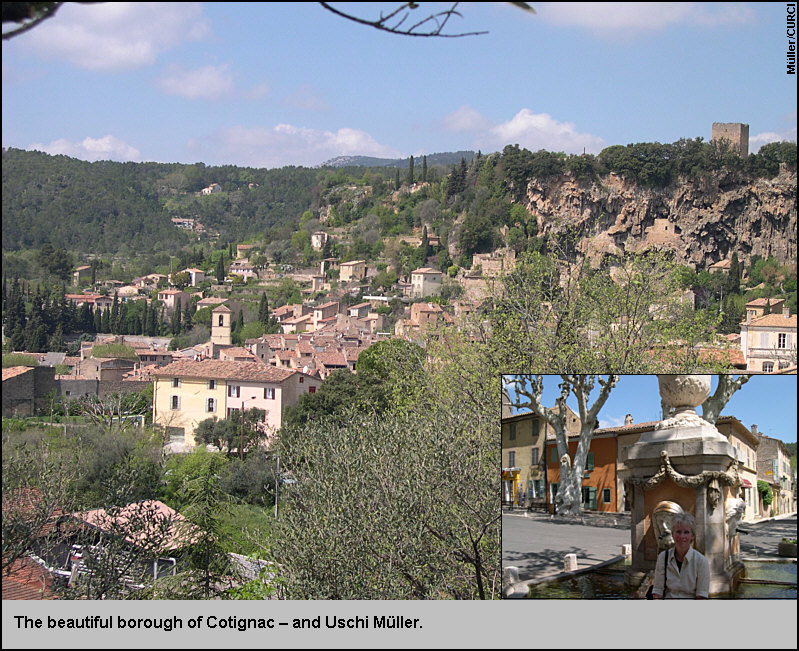
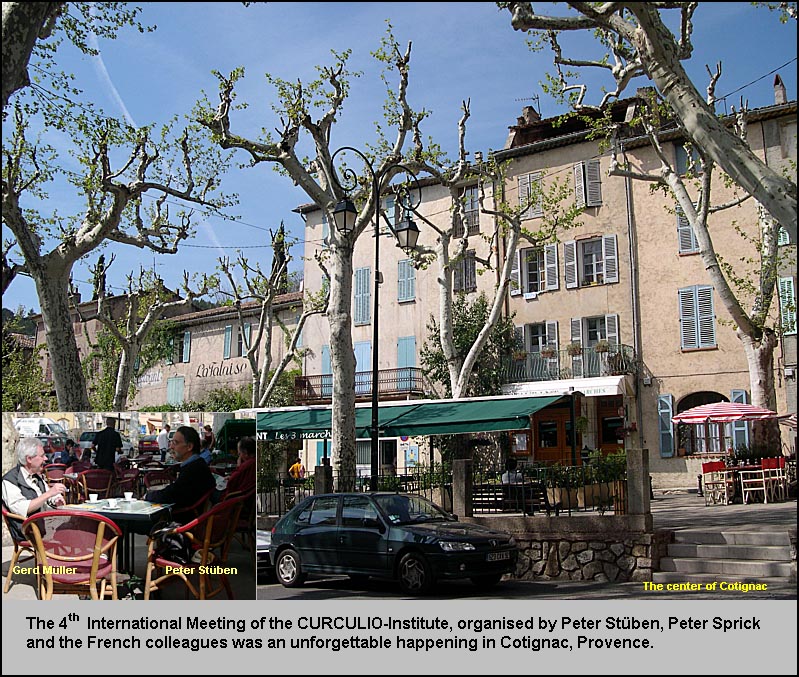
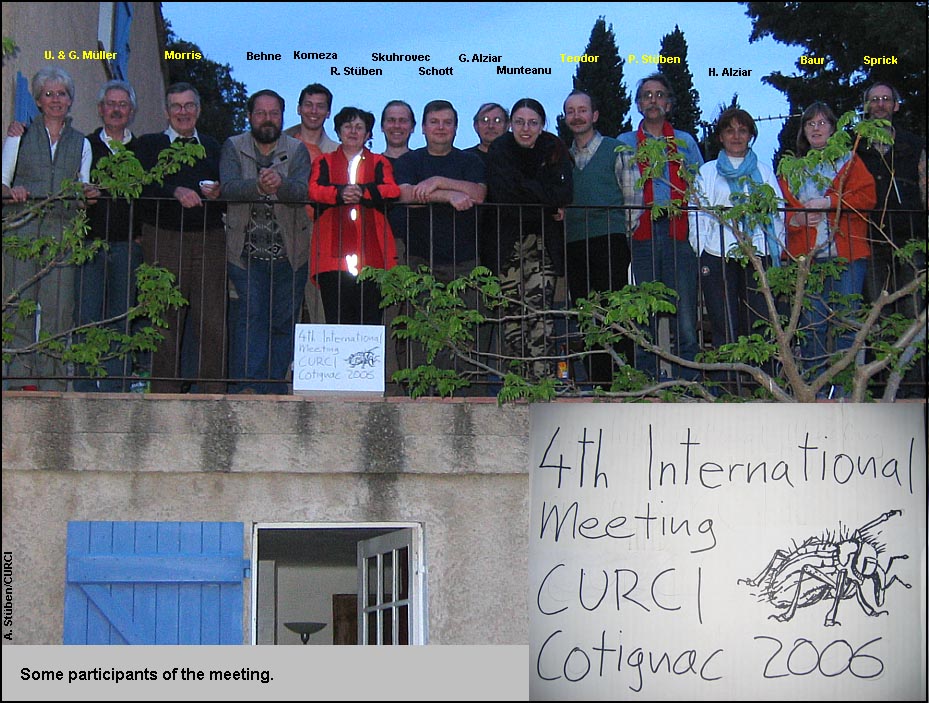
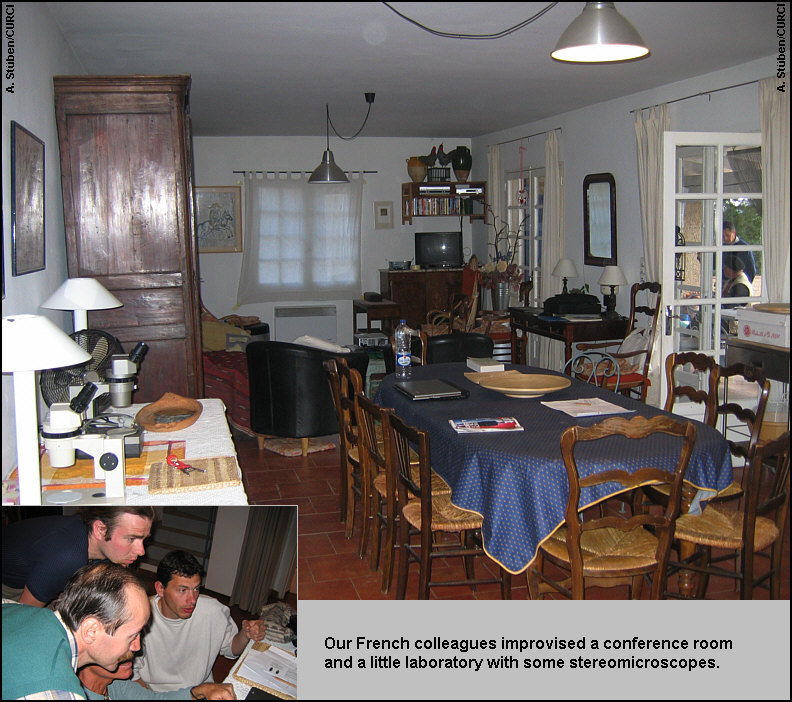
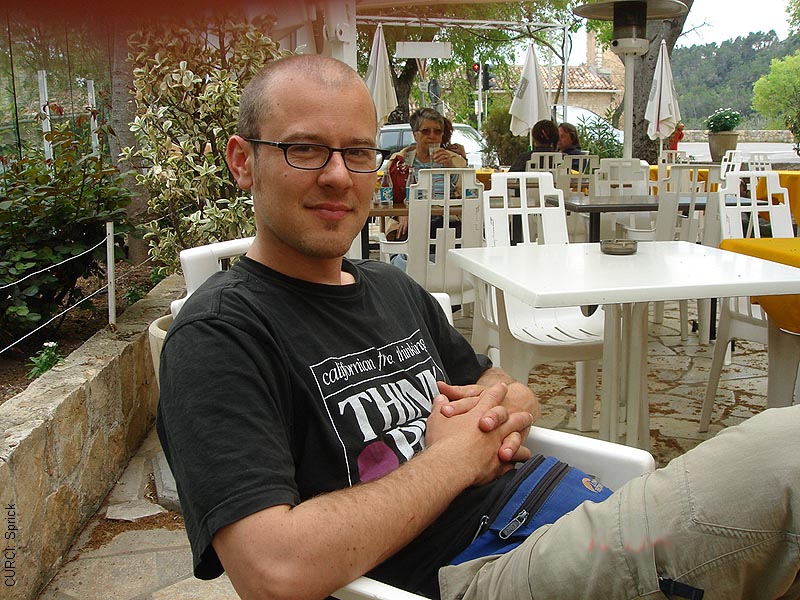
The 4th International Meeting of the CURCULIO-Institute, organised by Dr. Peter Stüben, Dr Peter Sprick and the French colleagues, took place this year in the peaceful borough of Cotignac [Fig. W34.1], [Fig. W34.2] in the middle of Provence (South France), in a Mediterranean climate. The accommodation “Les Terrasses” ([Fig. 34.3], [Fig. W34.4]) became a real “headquarter” for all participants coming from Czech Republic, France, Germany, Italy, Poland, Romania, Switzerland, and United Kingdom [Fig. W34.5]. - Here, our delegation improvised a conference room and a little laboratory with some stereomicroscopes [Fig. W34.6].
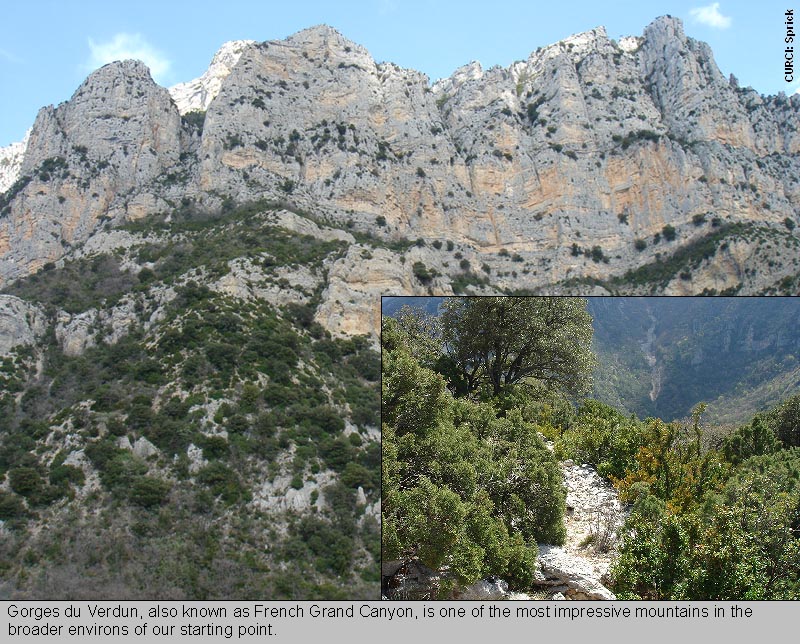
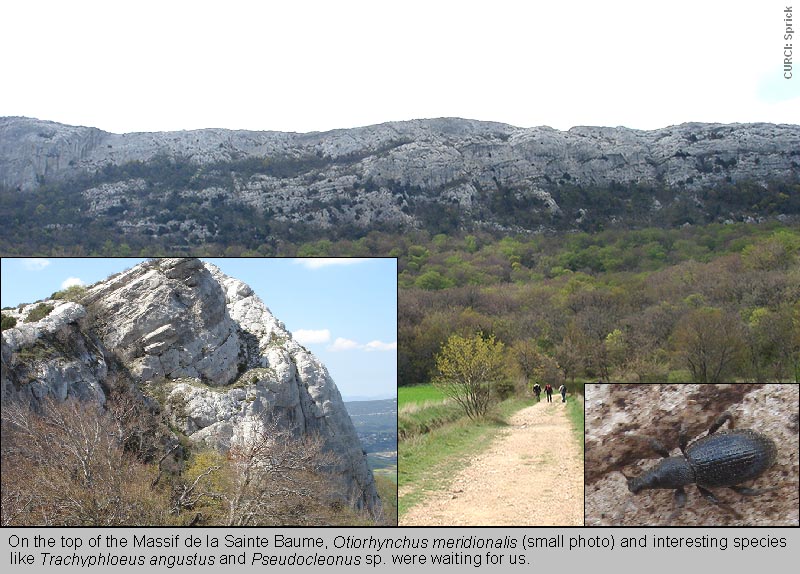
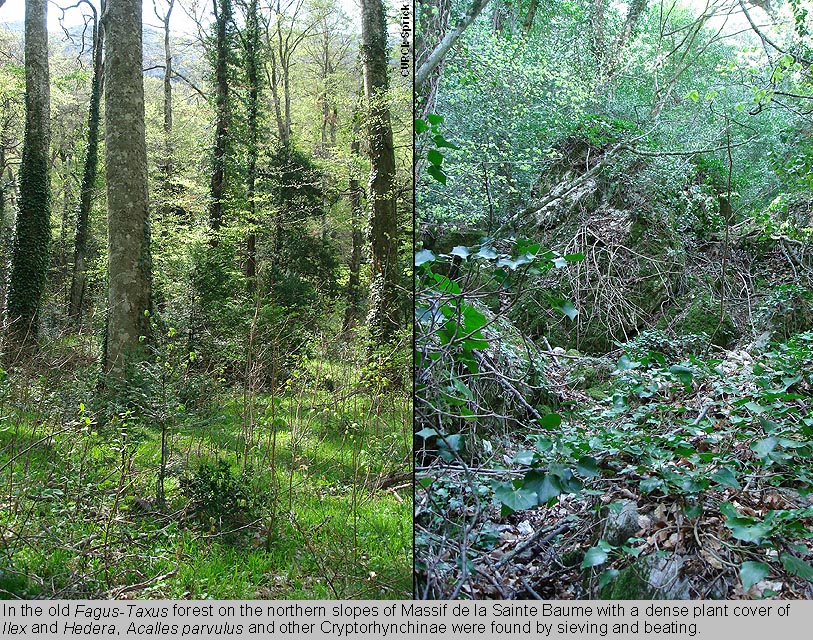
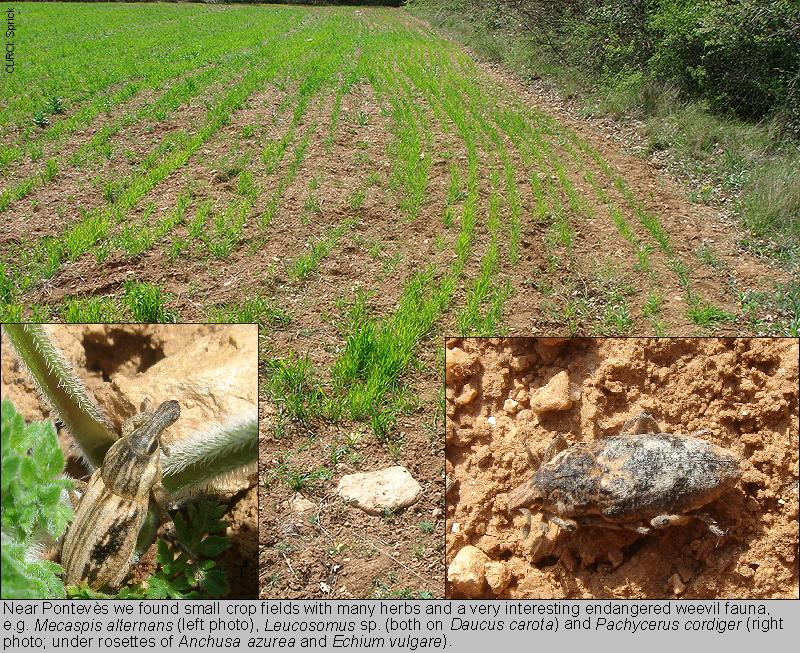
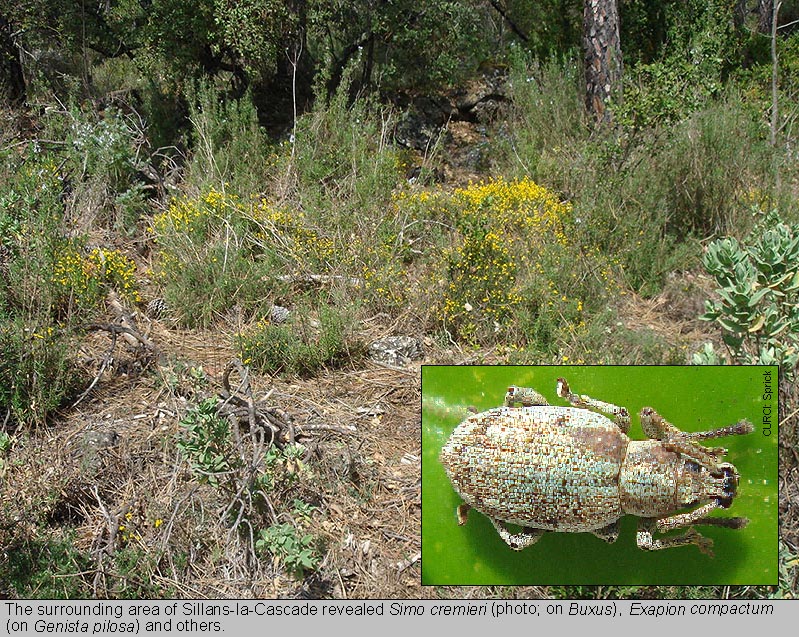
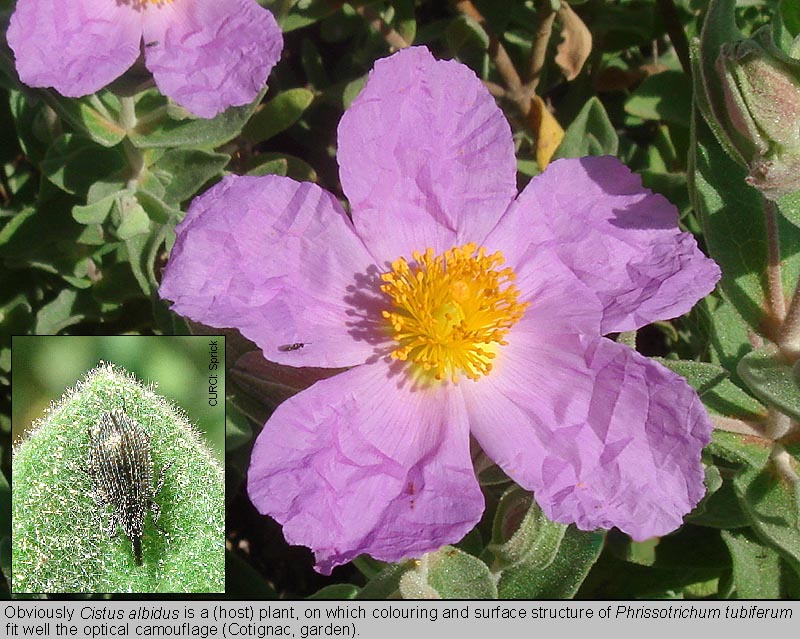
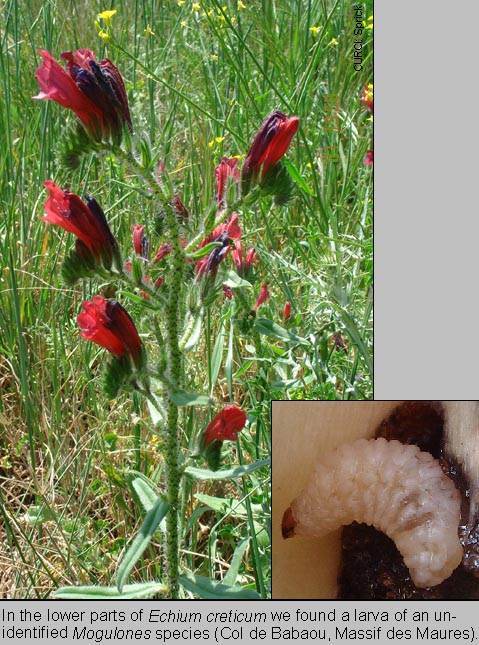
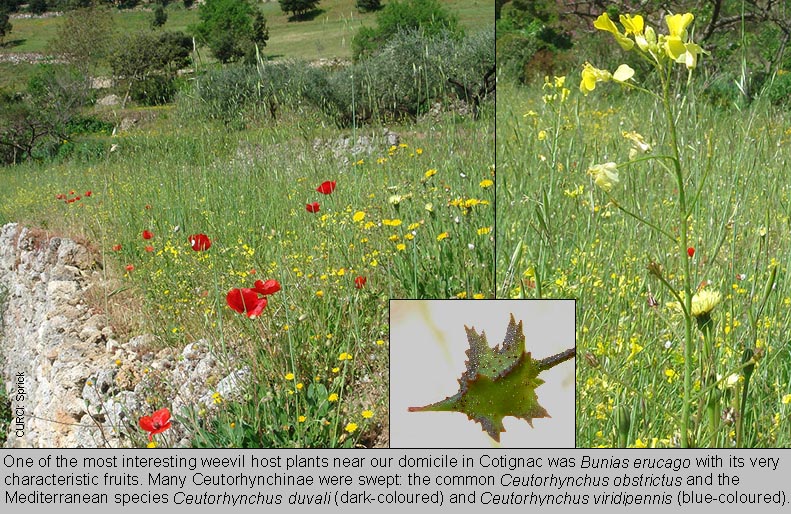
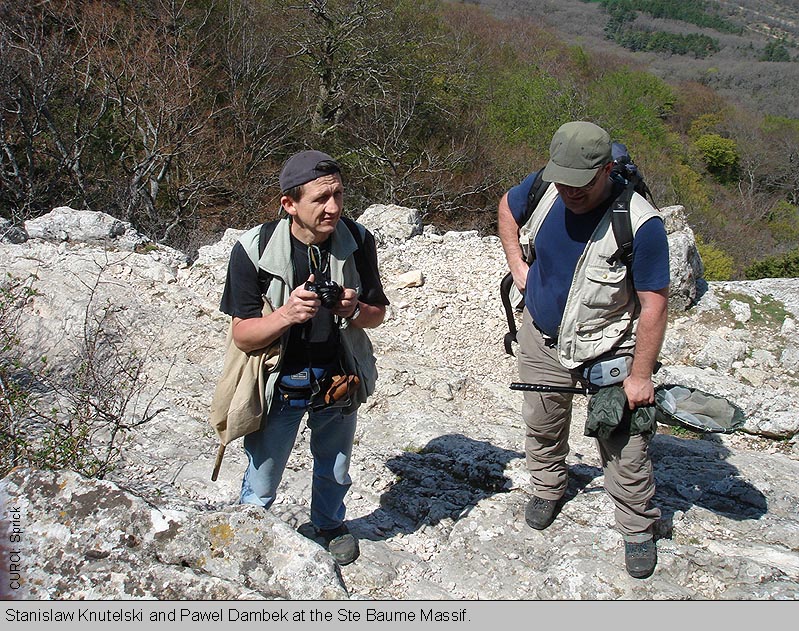
“Les Terrasses” was the place from where, the participants, forming small teams, went in long field trips to beautiful and interesting places. Philippe Ponel proposed the following sampling sites: Massif de la Ste Baume, Montagne de la Loube, temporary lakes of Centre-Var, Plaine des Maures, northern slopes of Massif des Maures, Chartreuse de la Verne, Abbaye du Thoronet, Entrecasteaux, and during the trip some other interesting places were visited: Gorges du Verdun, Vallée de l'Argens, Bras (Les Terres Blanches), Pontevès, Sillans-la-Cascade etc. [Fig. W34.7], [Fig. W34.8], [Fig. W34.9], [Fig. W34.10] [Fig. W34.11]. Our first mission in all these places: Searching for weevils! As many species as possible and especially the endemic ones like: Trachyphloeus angustus Borovec, 1989, Pleurodirus murinus (Gyllenhal, 1834), Simo cremieri (Boheman, 1843) [Fig. W34.12]. - Weevils and their host plants - another interesting way of studying weevils: [Fig. W34.13], [Fig. W34.14], [Fig. W34.15], [Fig. W34.16].
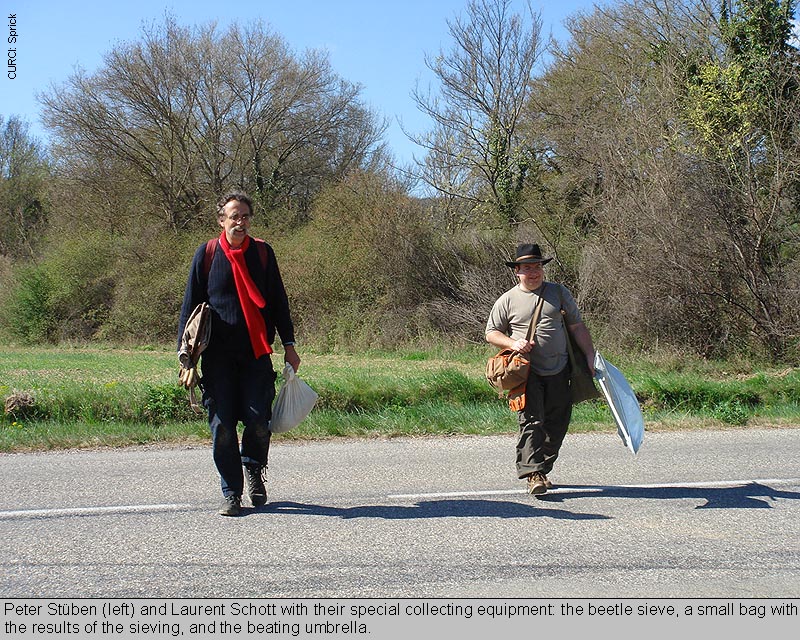
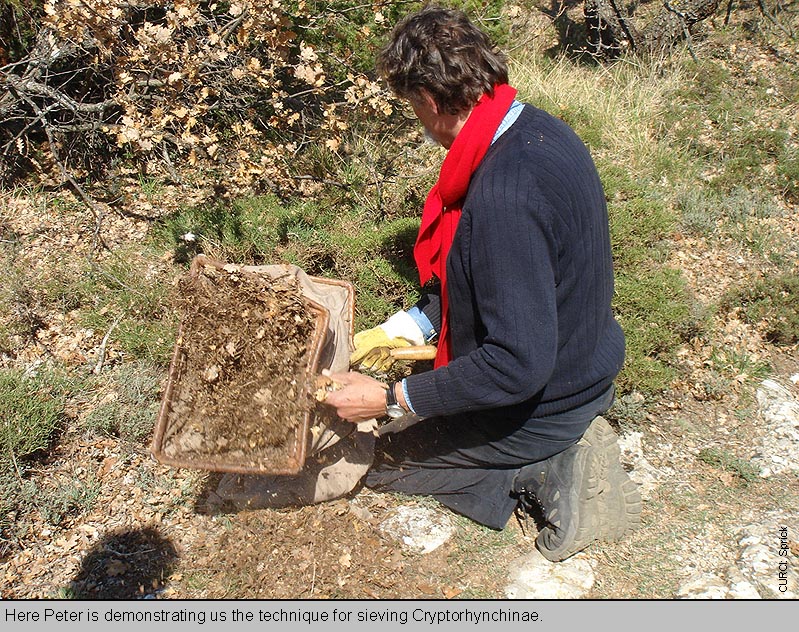
Forests, mountains, grasslands, temporary lakes, all have been examined with great attention using various collecting methods for weevils [Fig. W34.17], [Fig. W34.18], [Fig. W34.19], [Fig. W34.20]. The brilliant sun and our French colleagues, who many times were our guides, have assured the success of the missions and a pleasant atmosphere.
Lectures about curculionids (not only chasing them)
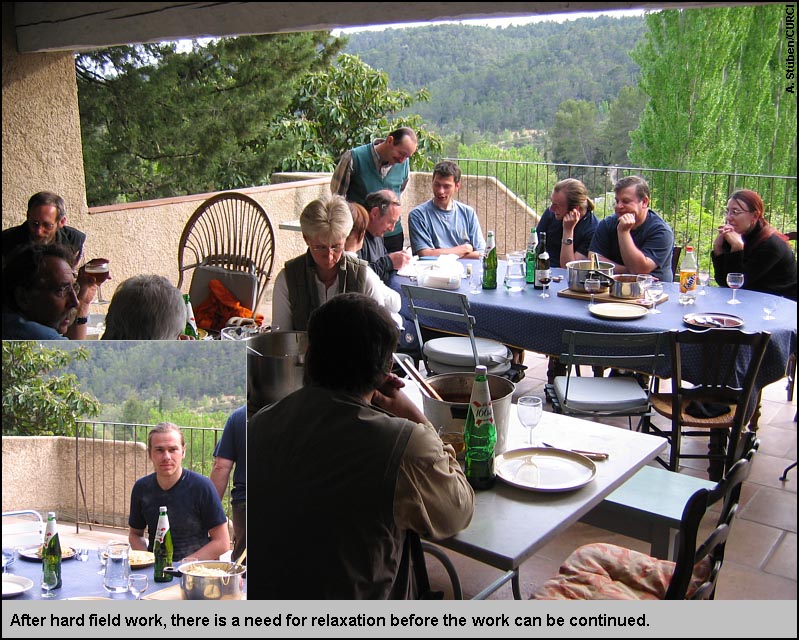
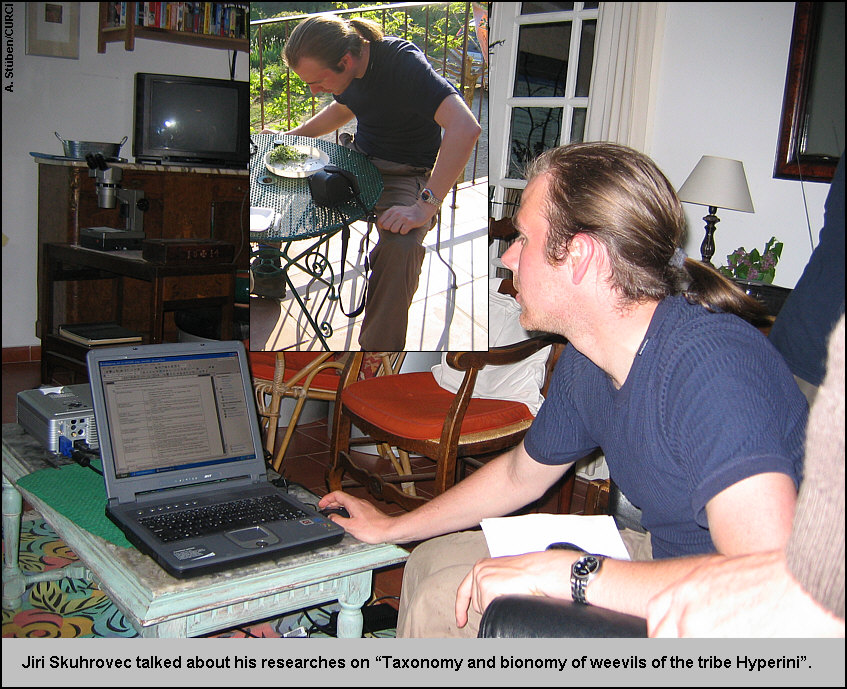
Almost every evening, after working hard during the day for finding beetles, the participants came together to share their experience [Fig. W34.21] with ever surprising weevils and listened some interesting lectures. The lectures, hold in an unusual conference room [Fig. W34.22], had various themes. A very actual problem: How to take a good picture of three-dimensional insects like our curculionids without spending the whole annual budget of the institution where you are employed or your annual income if you are amateur?
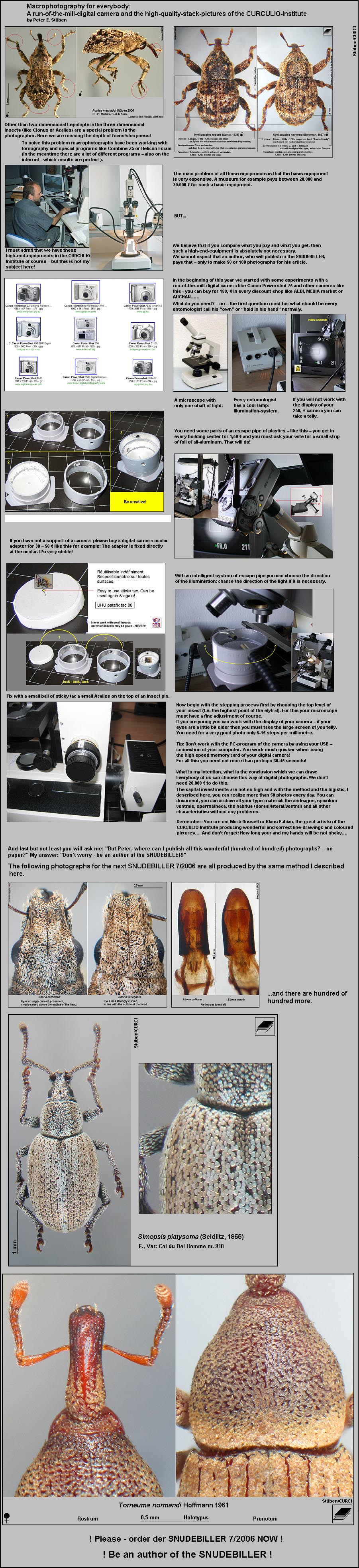
Dr. Peter Stüben demonstrated us that it is possible in his presentation named: “Macrophotography for everybody: A run-of-the-mill-digital camera and the high-quality-stack-pictures of the CURCULIO-Institute”. [Fig. W34.23] A microscope with only one shaft of light, a cool lamp with 2 flexible arms, parts of an escape pipe of plastics, a usual digital camera, a tripod or a digital-camera-ocular-adapter and the tomography-program COMBINE Z5 (free version) is all you need for starting a good quality tomography. So, with a few hundred Euros you can have the dreamed pictures of your insects! But take care, this procedure works only for little beetles (under 10 mm), for big ones you still need a special equipment.
The first steps of a beginner! Cristina Munteanu presented the correlation between some curculionid species and plant associations in the lecture “Curculionids species from natural habitats (Brasov - County)” which has as co-author a Romanian botanist, Dr. Simona Mihãilescu.
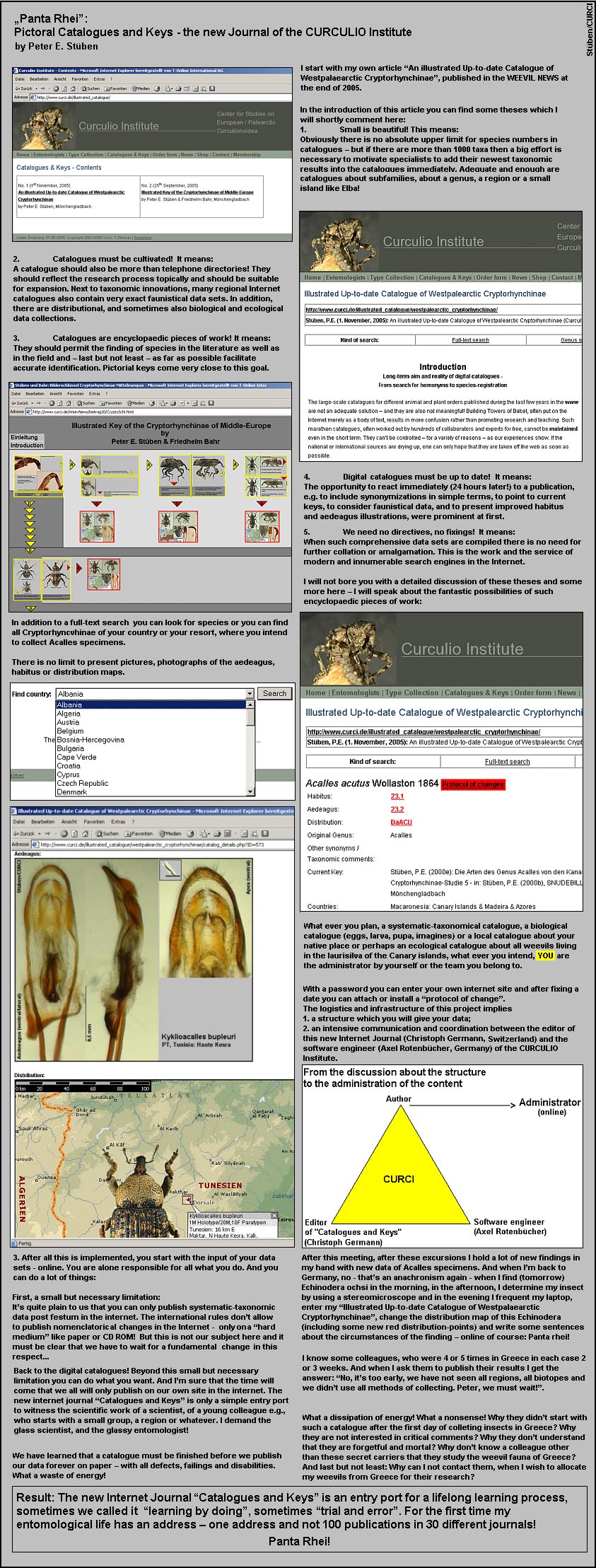
Can we identify species faster and easier? Pictorial keys and catalogues seem to be the way to do it. Dr. Peter Stüben presented the new journal project of the CURCULIO-Institute: “Catalogues and Keys”. [Fig. W34.24] The aim is to give specialists an instrument to publish their faunistical and taxonomical work faster and in a flexible manner.
Digital catalogues must be encyclopedic pieces of work that “should permit the finding of species in the literature as well as in the field and - last but not least - as far as possible facilitate accurate identification” (Peter Stüben).
Dream of any faunist! Finding new species for a region or a country. Our colleague Dr. Lucian Teodor has presented 4 new species of the Curculionidae fauna from Romania in a lecture named: “Weevil species (Coleoptera, Curculionoidea) that are new to the Romanian fauna”.
Status of some species! Classical methods describe species by morphological aspects. In the case of twin species this may have generated confusions. Lutz Behne prepared a list of Central European species which status should be checked by molecular biological analysis. So, don’t forget your ethyl alcohol 97 - 100% when you go in the field next time! [List of closely related weevil species pairs]
Phylogenetic relations between species, a very important aspect of taxonomy! Our colleague Jiří Skuhrovec accomplished some researches on “Taxonomy and bionomy of weevils of the tribe Hyperini (Coleoptera: Curculionidae)” [Fig. W34.25]. He analyzed 6 genera of Hyperini corresponding to a great extent with the original concept of the tribe presented by [Petri 1901] using adult and larval characters, and obtained interesting preliminary results which will orientate his further studies.
Organizing our future activities
Between field trips, lectures and other interesting discussions, the CURCULIO-Institute found the necessary time to perform its general annual meeting, too. As a result, the board of the CURCULIO-Institute is widened: Christoph Germann [Fig. W34.26] will manage the new journal Catalogues & Keys presented previously by Peter Stüben. [Fig. W34.24]
Delays or missing membership payments generated problems in the manage-ment of the organization. So, the general meeting decided to send the SNUDEBILLER CD Rom only to these members, who paid their annual fee.
Lucian Alexandru Teodor invited the CURCULIO-Institute for 2008 to Cluj/Romania. He will manage the meeting! A second proposal was Bulgaria, but there is no one who can organize it there. All members voted for Romania. It was also proposed to change the meeting regularly between (South) West and East Europe.
There is a need to make some ethical rules for cooperation, collecting and so on. The committee was installed now by the vote of all members: Enzo Colonnelli, Michael Morris, Laurent Schott, Stanislaw Knutelski, Peter Stüben (coordination) and Peter Sprick are members of the ethic committee.
Why not describe the new species in SNUDEBILLER and stimulate the new generation? Peter Stüben proposed to give as premium a digital camera to the beginners, who will describe the first 5 species in SNUDEBILLER.
Because identification of weevils is sometimes difficult using current keys, the Curculio team started in 2005 to continue the DVD (Digital Weevil Determination) project. The next SNUDEBILLER will provide a pictorial key to Sitona from Transalpina region, and the next groups will be Baris (in 2007) and Dorytomus (in 2008).
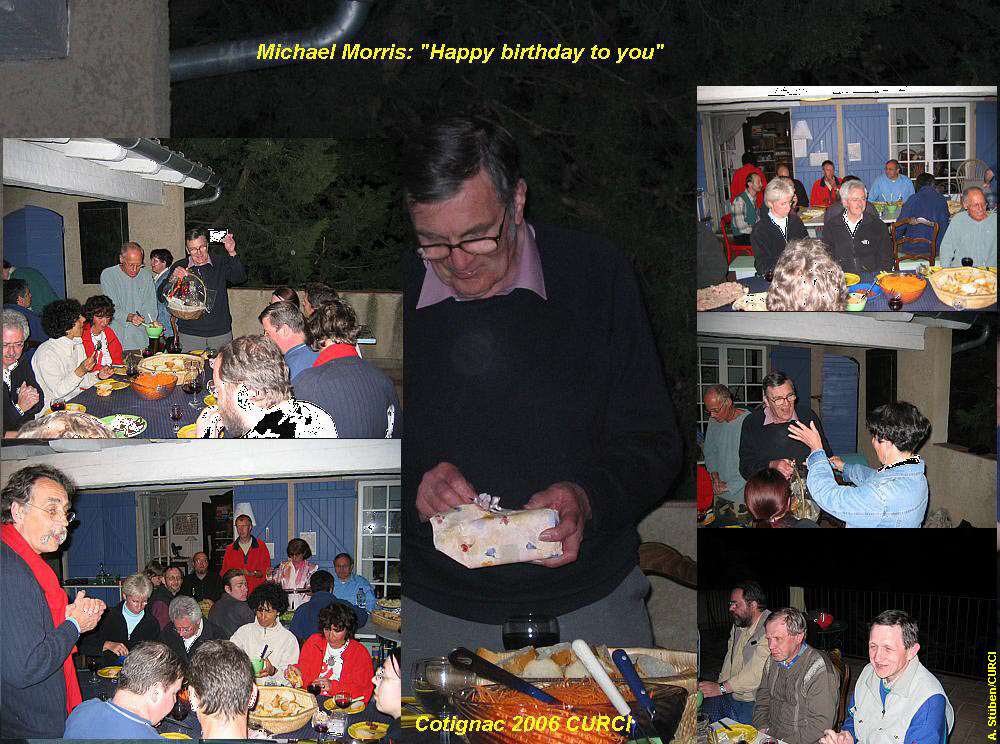
Even this meeting was not missing the events. On the 18th April we celebrated the birthday of a senior colleague - Michael Morris. The science was abandoned for several hours in favour of a great atmosphere. Gifts - special curculionids, special bottles of wines and champagne and singing “Happy birthday to you!” in every participant’s language [Fig. W34.27].
Conclusions
The French experience was in some aspects a continuation of the Poland meeting two years ago. Old relationships were fostered and new ones created. Learning from each other, still without grabbing for academically reputation is the force which traces the future of CURCULIO-Institute. In 2008 the meeting of the CURCULIO-Institute will be in Romania. Special places and a very diverse curculionid fauna are waiting for us.
Special thanks to our French colleagues and hosts: Gabriel & Hélène Alziar, Nicolas Komeza, Laurent Schott, Philippe Ponel, Dominique Menet and Eric Rouault.
Participants
Alziar, Gabriel & Hélène (FR); Baur, Ursula (D); Bayer, Christoph and Marion (D); Behne, Lutz (D); Bialooki, Piotr (PL); Büche, Boris (D), Colonnelli, Enzo & Giovanna and Annamaria (IT); Dambek, Pawel (PL); Germann, Christoph (SW); Knutełski, Stanislaw (PL); Komeza, Nicolas (FR); Menet, Dominique (FR); Morris, Michael (U.K.); Müller, Gerd & Uschi (D); Munteanu, Cristina Laura (RO); Petryszak, Boguslaw (PL); Ponel, Philippe (FR); Rouault, Eric (FR); Schott, Laurent (FR); Skuhrovec, Jirislav (CZ); Sprick, Peter (D); Stüben, Peter & Regine (D); Stüben, Alexandre (D); Teodor, Lucian Alexandru (RO).
References
Petri K. (1901): Monographie des Coleopteren-Tribus Hyperini. Siebenbürg. Ver. Naturwiss. Hermannstadt. II, 210 pp.
Adresses of the authors:
Cristina Laura Munteanu
Research Assistant
Institute of Biology - Romanian Academy
Centre of Ecology, Taxonomy and Nature Conservation
060031 Bucharest, Splaiul Independentei 296, P.O.Box 56-53
Tel: 0040 21 2239072, Fax: 0040 21 2219071, www.ibiol.ro
E-mail: cristina.munteanu@ibiol.ro; clmunteanu@gmail.com.
Lucian Alexandru Teodor
Lecturer Dr.
University "Babes-Bolyai", Faculty of Biology
Department of Taxonomy and Ecology
400006 Cluj-Napoca, Clinicilor 5-7, Romania
E-mail: LTeodor@clujnapoca.ro; lucianteodor@yahoo.com.