|
Weevil
News |
No. 16 |
10 pp. |
20th November 2003 |
ISSN
1615-3472 |
|
|
Stüben,
P.E. (2003): The Rediscovery of Acalles
droueti Crotch 1867 and Curculionoidea collected on an excursion on
the Azores: A Report. (Coleoptera: Curculionidae: Cryptorhynchinae) -
Weevil News: http://www.curci.de/Inhalt.html,
No. 16: 10 pp., CURCULIO-Institute: Mönchengladbach. (ISSN
1615-3472). |
|||||
The
Rediscovery of Acalles droueti Crotch 1867
and Curculionoidea collected on an excursion on the Azores:
A Report*
(Coleoptera: Curculionidae: Cryptorhynchinae)
by
Peter E. Stüben, Mönchengladbach
with
36 figures
Abstract
Acalles
droueti Crotch 1867 was rediscovered in Euphorbia stygiana on the islands of Pico and Faial during a trip to
the Azores in the summer of 2003. The biology, ecology, and habitat requirements
of these species are described. A list of Curculionoidea that were also
collected and new finds is given in the Appendix.
Key Words
Coleoptera, Curculionidae, Cryptorhynchinae, Acalles
droueti, biology, ecology, host-plant, Euphorbia
stygiana, Portugal, Azores.
Introduction
I received syntypes of Acalles
droueti Crotch 1867 from the Natural History Museum in London in November
2002. In connection with my work on the Second Analytical Catalogue for
Cryptorhynchinae [Stüben, Behne & Bahr 2003: 32], I designated lecto- and
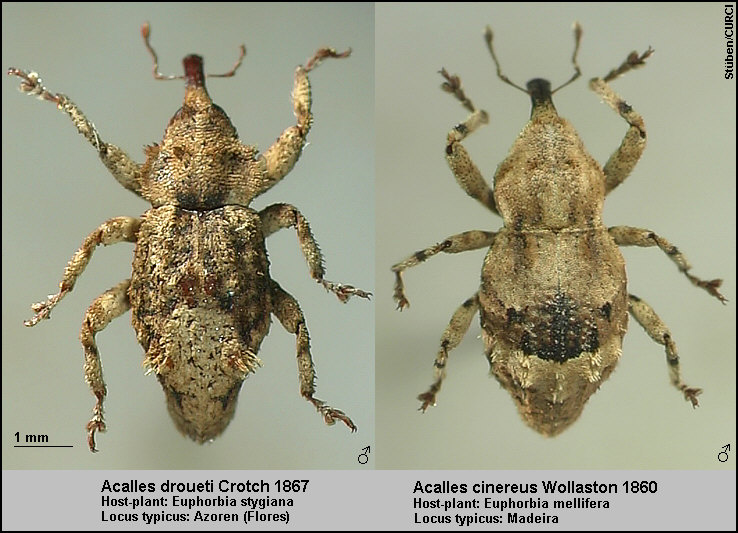
paralectotypes (of the the species) and photographed its habit and aedeagus with
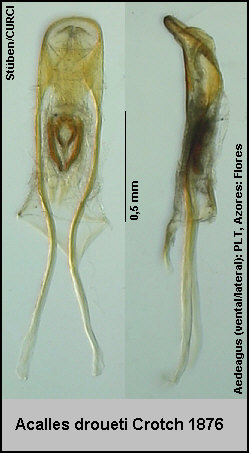
a high-resolution digital camera. [Fig.
DR27][Fig. DR29]
This work convinced me that I wanted to document, for
the first time in 130 years, the presence of this Cryptorhynchinae in the
Azores, without a doubt the most beautiful Cryptorhynchinae of the western
Palaearctic region. The information available about this unusual species in the
western Palaearctic was anything but encouraging. The only thing that was said
the first time it was described was "Hab. in ins. Flores intra euphorbiam
emortuam sat copiose lectus" [Crotch
1867]. Israelson mentioned only that this
species and a few other endemic species had apparently not been found in the
previous hundred years.
[Israelson 1990: 7]
I
visited the Azores from July 31 to September 2, 2003, spending a week each on
the islands Terceira, Flores, Pico, Faial and São
Miguel. I was very hospitably received by Paulo Borges of the University of
Azores – Dep. of Agriculture on Terceira (Angra do
Heroísmo).
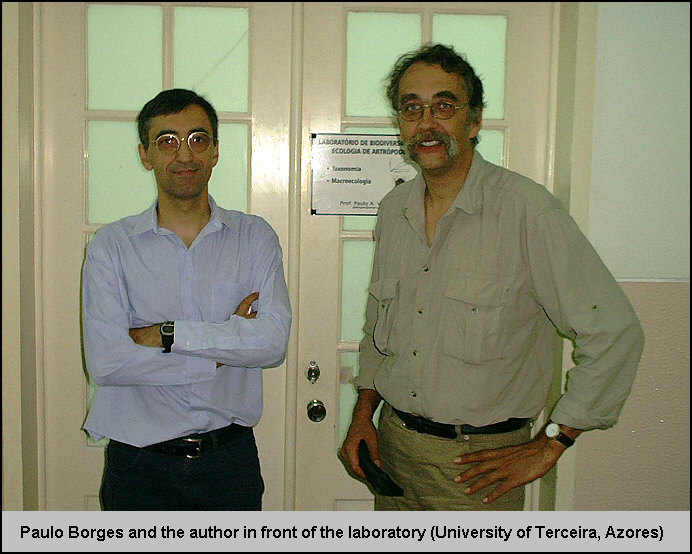
[Fig. DR30] I
was permitted to work in his laboratory, received access to the collections, and
received considerable useful information about the possible occurrence of the
host plant, Euphorbia stygiana Wats.,
on Terceira and Flores. It was one of the most difficult, but also one of the
most successful excursions I have made in the last several years.
Logistics, Methods, Disappointment
First, the area of possible occurrence of the host
plant had to be defined. In one regard, G.R. Crotch could not be mistaken: The
six syntype specimens (5 male/1 female) were immature, i.e., they had to have
been taken from within a branch, and cannot have been ‘guests’ - occurring
only occasionally in a dead branch of a Euphorbiaceae. Adult Cryptorhynchinae
are known to remain in the host plant for several weeks after emerging from the
pupa [Stüben
2003b]. The question was only which Euphorbiaceae did
Crotch find them in 1867. Without a doubt, the immigrants from North America
were to be excluded: Euphorbia
maculata
L. (all islands except Corvo), Euphorbia nutans Lag. (Faial)
and Euphorbia marginata Pursh. (Santa
Maria, Faial). I concentrated on the two endemic
species Euphorbia azorica Seub. (all
islands) and Euphorbia stygiana Wats. [Schäfer
2002]
Acalles
droueti has
very long legs, typical of the known species of the
laurel forests of the Canary Islands and Madeira. Moreover, the narrow habit
with long bristle tufts on the elytra are similar to the species that live in
trees on all of the Moroccan islands, which I have described and redescribed in
numerous publications over the last several years.
[Stüben 2000e][Stüben 2000k] [Stüben 2002] Because
the species can get to be 5.5 mm across,
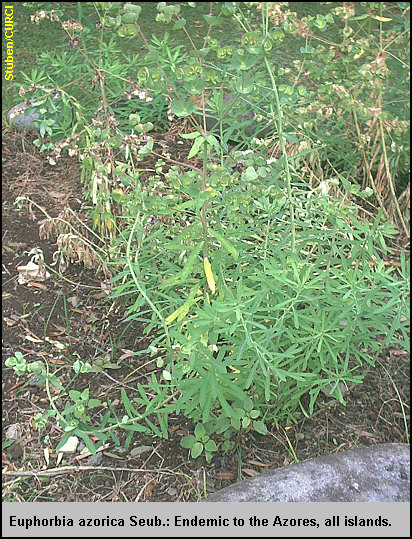
Euphorbia azorica [Fig.
DR1], a low, herbaceous plant in coastal
areas below 100 m elevation, could not be the host plant. A very good
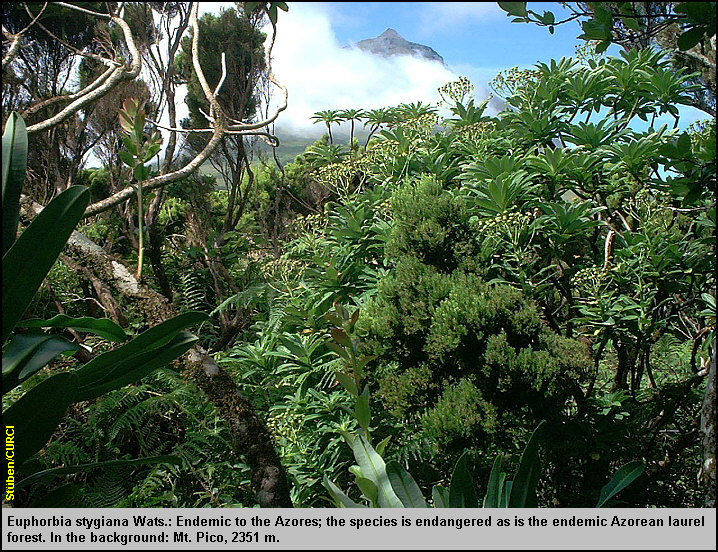
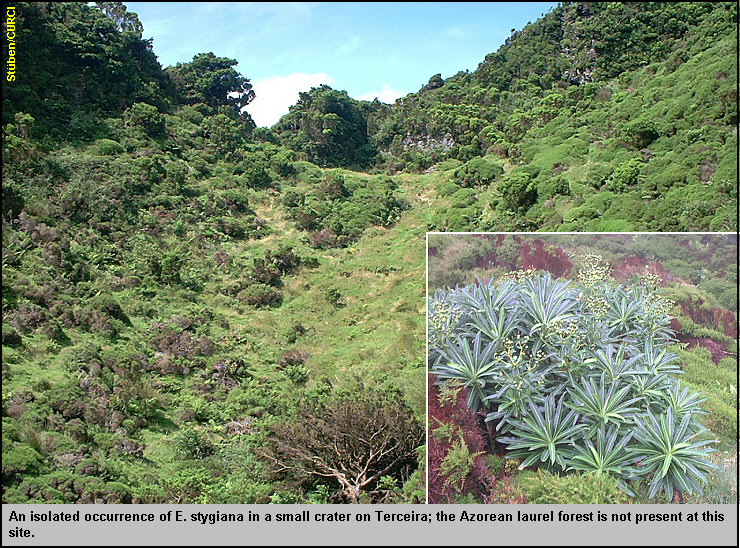
possibility was Euphorbia stygiana [Fig.
DR2], which grows as high as 5 m and
prefers the same habitats that the tree-like Euphorbia
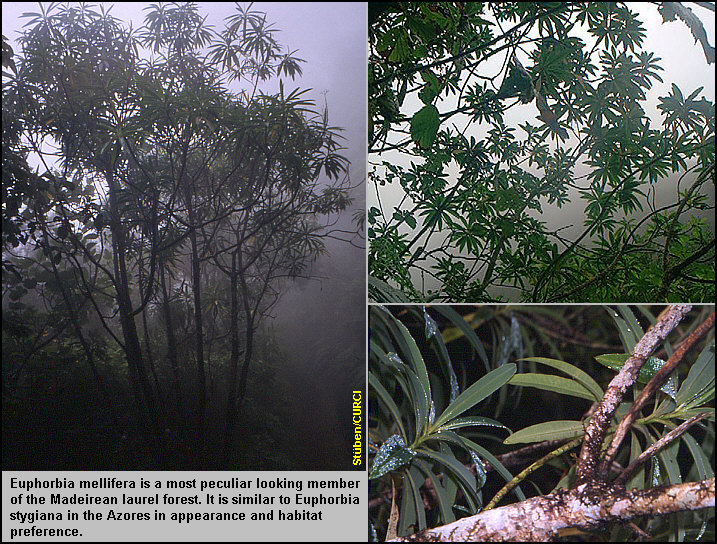
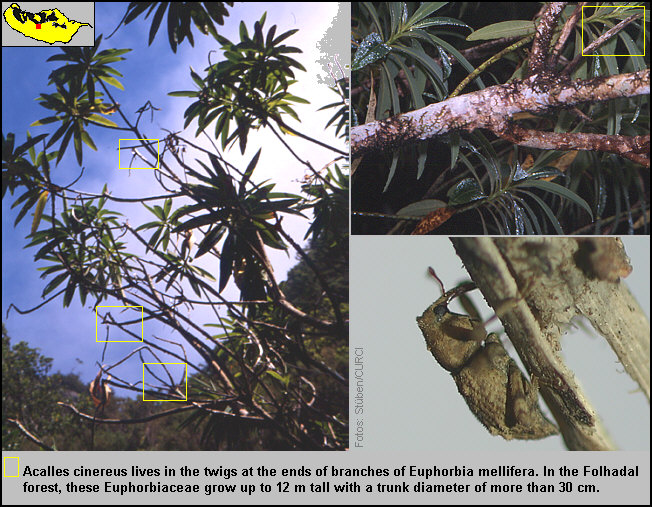
mellifera Ait. on Madeira [Fig.
DR3] and several of the Canary islands. It
is – or better was – a regular part of the laurel forests of the Moroccan
islands, growing in canyons, volcano craters, and in the moist habitats of the
laurel-juniper forests continually wrapped in fog. [Sjögren:
2001].
On
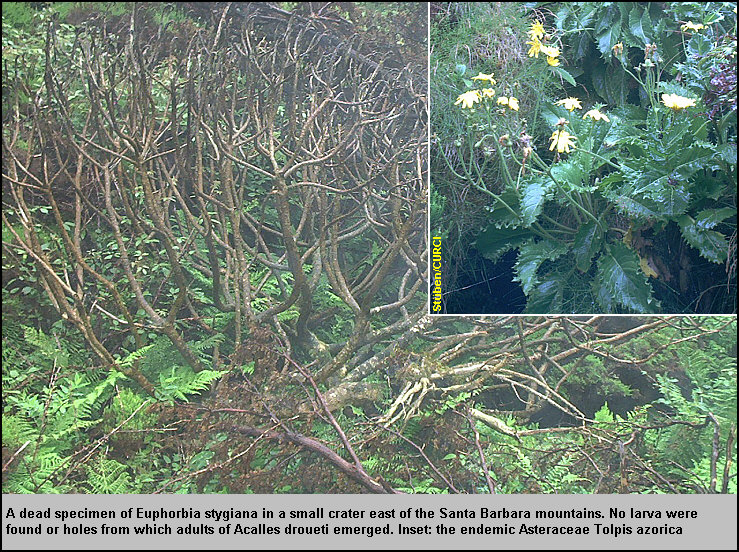
Terceira and Flores, this first hypothesis led to disappointment. I found eight
living [Fig.
DR4] and one dead Euphorbia
stygiana [Fig.
DR5] in a small crater (Pico
Gaspar) near the lake 'Lagoa do Negro' east of the
Serra de Santa Barbara mountains on Terceira. In vain! The site at which I found
this rare and endangered plant was much too isolated for Acalles droueti to be
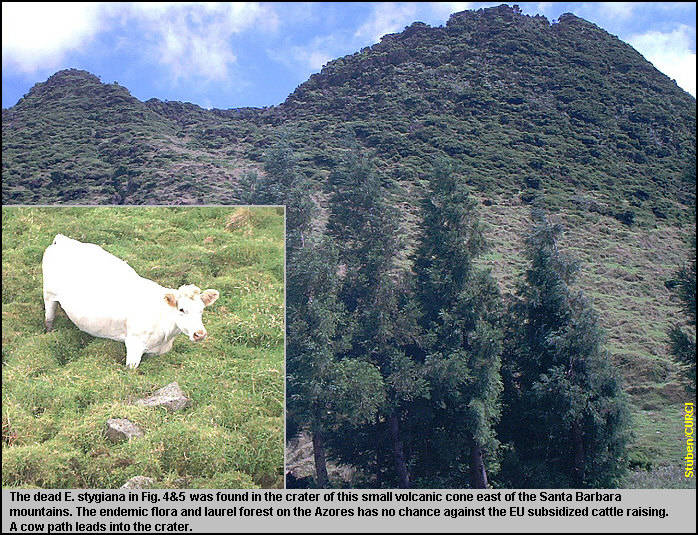
present, the plants were no higher than 1.5 m, and Azorean laurel forests
were nearly completely absent, which was certainly due to anthropogenic
influences – clearing and occasionally grazing. [Fig.
DR6] The same situation was found on
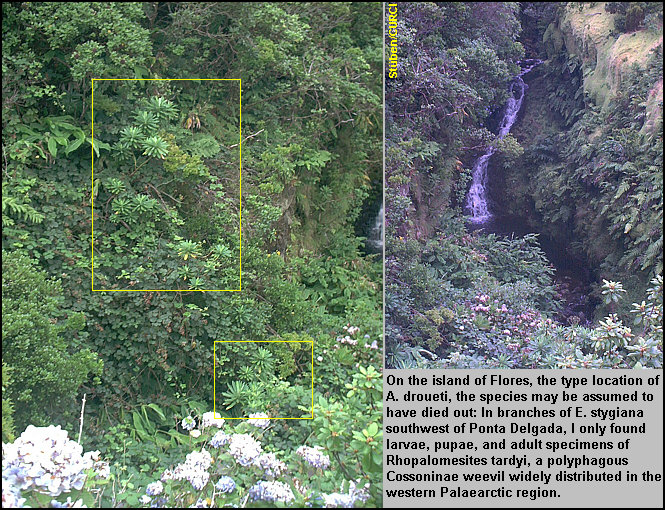
Flores, the type location. I found five plants in a steep-sided valley southwest
of Ponta Delgada. [Fig.
DR7]. I was able to take larva, pupa, and
adult specimens of Rhopalomesites tardyi (Curtis
1825) from the dead branches, but the site was
immediately adjacent to a bridge built only a few decades ago, so the plants
could not be very old. Upstream from the bridge I found no further Euphorbia
among the hydrangea (Hydrangea
macrophylla (Thunb.) Ser.), with its dense root
system, and Pittosporum undulatum
(native to southeast Australia), the greatest threat for the remainder of the
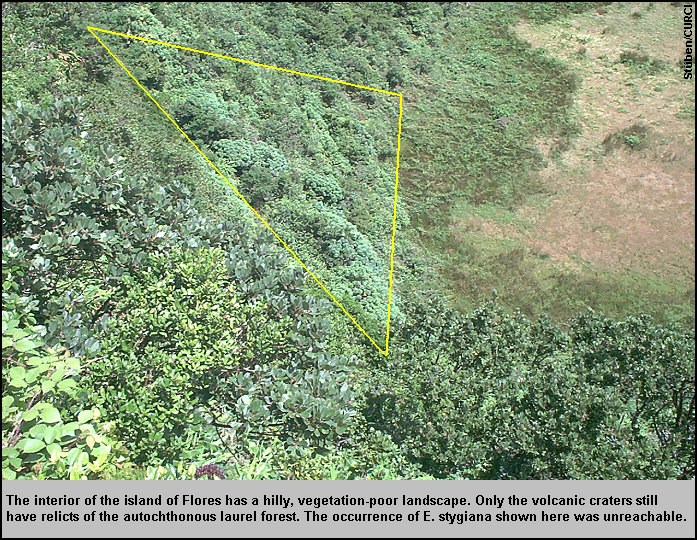
endemic Azorean flora. There was some hope when I discovered – in the nearly
completely deforested island interior, except for a few resistant junipers – a
relatively large occurrence of Euphorbia
stygiana [Fig.
DR8] at
the bottom of the steep crater Lagoa Seca, 60 m below the crater edge.
But for me it was unreachable without a rope or alpine experience.
Difficult search on Pico
Relatively large stands of
Euphorbia stygiana were found
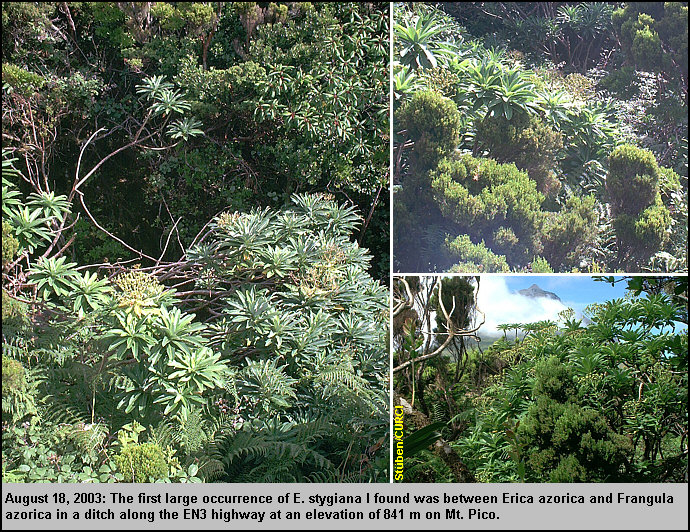
only on Pico, the third island of my trip. [Fig.
DR9] A large group was found on August 18,
2003, at the side of the road EN3 across Pico volcano, which rises to an
elevation of 2351 m on the north side of the island. The specimens were up to 5
m high, some of them uprooted by the stream at high water, some of them dying.
They were in a residual Laurus forest with the typical bush and tree species of this kind of forest: Laurus
azorica (Seub.)
Franco, Vaccinium cylindraceum J.E. Sm.,
Erica azorica (Hochst.) D.A. Webb,
Ilex perado Ait. ssp. azorica Tut.,
Viburnum tinus L. ssp.
subcordatum (Trel.) P. Silva, Frangula
azorica V.Grubow and – of course – Euphorbia
stygiana.
Standing
in the wet roadside ditch, I cut open dead or dying branches and roots for hours
and – initially just as unsuccessful – sieved through the leaves and twigs
on the ground. Perhaps Crotch did mean the coastal Euphorbia
azorica, which prefers a distinctly drier habitat.
At
the base of the large Euphorbiacae, I was reminded of a situation years ago in
the primary laurel forests of central Madeira ("Folhadal").
Christoph Bayer from Berlin and I had searched unsuccessfully for days for Acalles
cinereus Wollaston 1860 under Euphorbia
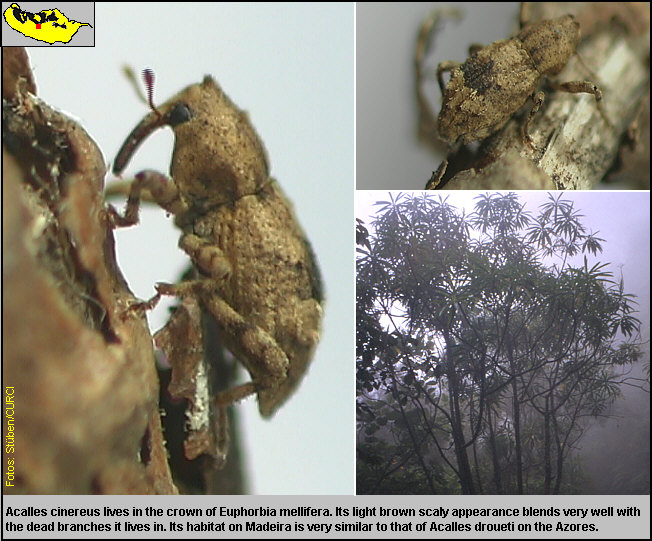
mellifera trees up to 12 m high. [Fig.
DR10] [Fig. DR28].
We finally found larvae, pupae, and immature specimens
at the ends of dead branches in the top of the trees [Fig.
DR11] [Fig. DR12],
confirming Wollaston's description of the host plant after 140 years. [Stüben
2002] Climbing these Euphorbiaceae, which bent from their own weight, was not
particularly safe, and the white latex sap, toxic to insects [Sprick
& Stüben 2000], oozed out from the slightest
injuries to the plant, sticking to clothes and hair, was quite unpleasant. The
search on Pico for a highly specialized insect which avoided the toxic sap by
living only in dead plant parts became increasingly more difficult.
It
is difficult to describe the blissful feeling that I had when, more than 130
years after it was first described, I found larvae, pupae, and immature
specimens of Acalles droueti in
the dead, hollow branches at the top of this endemic Euphorbia.
[Fig.
DR13]. The dead, dark-colored leaves at the
top of the tree contained dozens of these uniquely colored Cryptorhynchinae. [Fig.
DR14]
On
the same day, further Acalles droueti
were found in Euphorbia
stygiana at the intersection of the road EN3 with the EN2, where plants with
a diameter of 20 – 35 cm at the base stood in a depression. I had already
unsuccessfully knocked on these plants in my search. The insects retreat into
the dead ends of the branches of the crown during the day. Even the most severe
storms are not able to injure them in this refuge, so it is not surprising that
they haven't been previously knocked out of their dead, hollow branches by
entomologists. If the dead, bleached branches can be reached and broken off, the
larvae, pupae, and immature specimens can be collected so that the eating
behavior of the larva, the making of the pupal chamber and the emerging
from the pupa can be observed.
(While
I am writing this during the late hours, specimens of this species are
copulating in my insectarium on my desk. The eggs are deposited on a dying Euphorbia
stygiana branch about 30 cm long. I am optimistic that within a few
months I will be able to describe all phases of development – eggs, larvae,
and pupae – in SNUDEBILLER...)
Discovered
today, described tomorrow, and extinct day after tomorrow?
I found Acalles droueti at only two other places on Pico. [Fig.
DR 34] The largest occurrence of the host plant Euphorbia
stygiana was at the foot of the east side of Pico's highest volcano, Pico da
Urze (899 m). Specimens of this Euphorbiaceae grow in the relatively small
crater, especially on the steep, north-facing slopes, often forming large
stands of tall trees. Large numbers of Acalles droueti were found in the
ends of hollow, bleached branches of tall plants in a deep gulch. The dead
branches in the crown, towering above the roof of the forest, could be
"harvested" from the edge of the gulch. I also used this method at a
small crater (Cabeco das Rochinha) in the easternmost part of Pico that I found
using my knowledge of the ecological niches of Acalles droueti. During
the day, it retreats only into absolutely dry, hollow, thick-walled, about 1 cm
thick branches of Euphorbia stygiana
in very old stands at extremely humid sites protected from the wind.
The plant prefers locations on the
steepest slopes just below the rim of the crater, from where – with some
daring and dexterity – the insects can be collected.
Of
course, after finding this easternmost discovery site, not far from the town of
Calheta de Nesquim on the coast and the large occurrence at the foot of Pico da
Urze, I made every effort to find all occurrences of Euphorbia
stygiana to determine whether they
contained populations of the flightless Acalles droueti. But in
the interior of the island between the coastal towns of Lajes do Pico and
Prainha, I found no weevils during a three-day search in the "Reserva
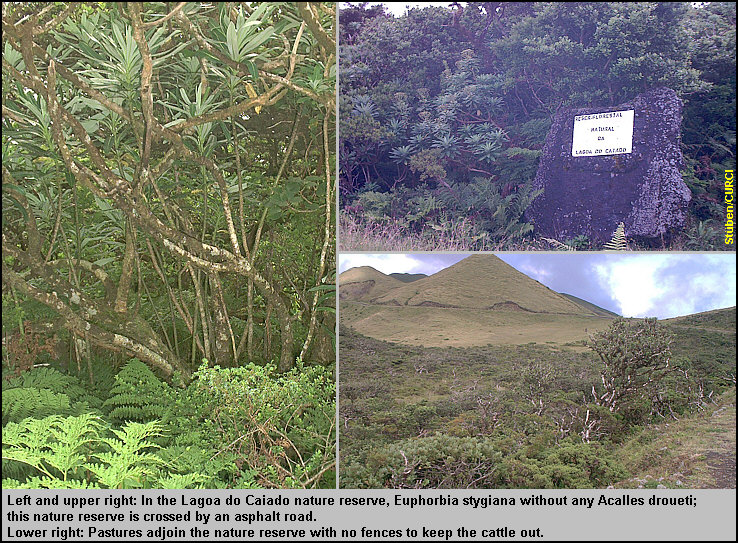
Florestal Natural da Lagoa do Caiado". In this
area on only a few hectares there is a residual primary laurel forest in thick
beds of Sphagnum moss. In
the branches of this – surely the most beautiful and least affected by
anthropogenic influences – stand, I found only Tarphius
depressus
Gillerfors (Col., Colydiidae; P.
Borges det.),
although the Euphorbia
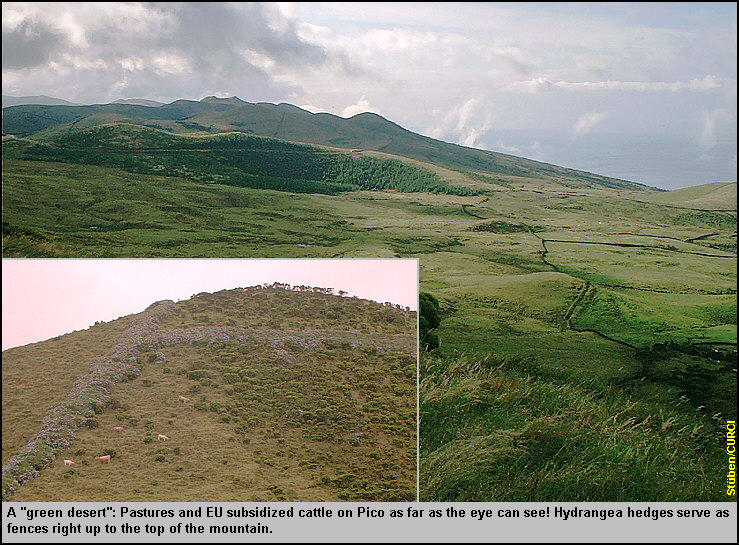
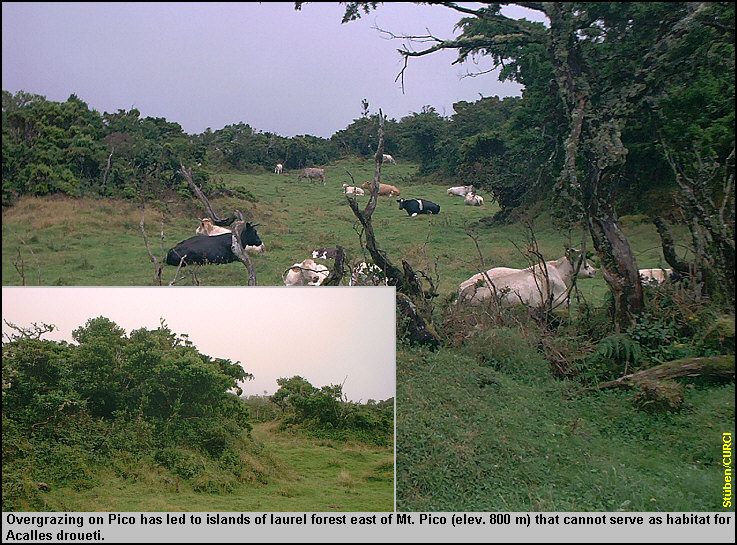
stands were very old. Even on Pico, the Azorean island least affected by humans,
all of the relict laurel forests between 600 and 900 m are separated by km-wide
pastures (subsidized by the EU funds for regions at the EU margin)
[Fig.
DR15],
the Cryptomeria
japonica plantations are being expanded at an
unbelievable rate [Fig.
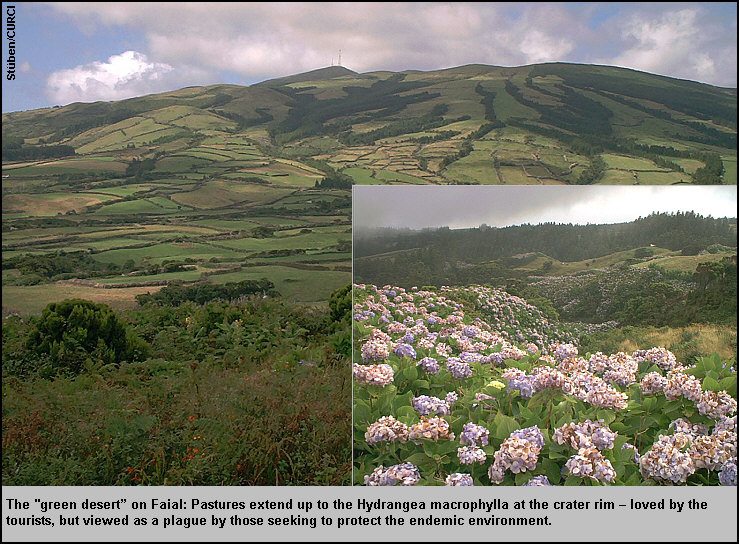
DR16], and a "green desert" has
been created by the often "unintentioned" introduction of new plant
species from all parts of the world: Pinus
pinaster (southwestern Europe), Cryptomeria
japonica
(Japan), Hydrangea macrophylla
(Japan), Pittosporum undulatum
(southeastern Australia, up to 600 m), Hedychium gardnerianum (Himalaya). Sphaeropteris cooperi (Australia) and Eucalyptus
globulus (Tasmania) are only some examples of a nearly complete change in
the flora of the Azores. Hundreds of other introduced plant species could be
named that have brought the very sensitive endemic island flora to the edge of
extinction.
The
nature preserve on the lake "Lagoa do Caiado" on Pico is no exception
to this development. The protective fences are torn down to allow cattle to
graze in the forest; EU-subsidized road construction is replacing the dusty
trails with wide asphalt highways that go through the middle of nature preserves
of only a few hectares, promoting tourism into the most remote corners of the
island. [Fig.
DR17]. Small craters are opened to grazing,
serving as a natural corral; the rims of large caldeiras are removed so that the
interior can serve as a wind- and weather-protected pasture. [Fig.
DR18]
I
made every effort to find the last relicts of laurel forests in the craters on
Pico and found only small stands of Euphorbia
stygiana. For days I examined laurel stands on the pastures – each only
several meters square – between Pico da Urze and Lagoa da Capitao. [Fig.
DR19] The elation I experienced with the
rediscovery of Acalles droueti was
increasingly overlain with disappointment. I still find it difficult to suppress
my anger about this extreme case of "ecocide", unparalleled anywhere
else in the world. Acalles droueti is
an example that shows the existence of the host plant is not sufficient if the
microclimate and microecological conditions are not present. The species prefers
an extremely moist site. It will leave the dead branches and leaves only if the
humidity between a dense forest roof and a thick Sphagnum bed is high enough. This is shown by the first breeding attempts
(see SNUDEBILLER 5/2004). Under the present conditions on the island, the fall
and winter winds blow unhindered through the islands of laurel flora on the
extensive pastures, the trampling of the soil increases drainage, causing the
islands of laurel to gradually dry out during the hot summer months of little
rain. What remains are tree skeletons [Fig.
DR20], and the nearly certain prediction
that the four sites at which Acalles
droueti and Euphorbia stygiana have been identified on Pico will not be
sufficient to stop the fragmentation of the populations which prevents genetic
exchange between the subpopulations. This is not only the case for these two
species, but for all other endemic, highly specialized phytophagous insect
species with a rather narrow ecological niche, as I have already demonstrated on
the Madeira Islands. [Stüben
2002: 158-168]
What remains is the Caldeira do Faial Nature
Reserve…
For an entomologist, the
highpoint of any trip to the Azores is the large Faial caldeira, which today is
part of the Caldeira do Faial Nature Reserve and still contains a largely
autochthonous flora and fauna [Fig.
DR22]. I received all of the information I
needed from
Eng. João Melo, the Director of the Faial Botanical
Gardens, who was able to give the exact locations of many of the endemic
species. It was only a question of the weather when I could visit the caldeira,
which has a nearly 400 m high rim and is about 1.5 km across. [Fig.
DR21]
Euphorbia
stygiana occurs in large stands on the inside of
the northeastern rim about 100 – 250 m below the rim. The katabatic winds and
steep slopes have created a creeping form (up to 6 m long) of the species. [Fig.
DR23] As on Pico, Acalles droueti was not found in the numerous dead branches on the
ground. Larvae, pupae, and immature specimens were found, however, in the dry
stems just below the tree crowns above Sphagnum
beds up to 80 cm thick.
The
Cabeco Gordo at the rim of the Faial caldeira reaches an elevation of 1043 m,
and except for the southwest side the caldeira is used only for cattle raising
and forestry. [Fig.
DR24] The pastures and Cryptomeria
forests end at the caldeira rim, along which there is a 5 m wide
Hydrangea macrophylla hedge.
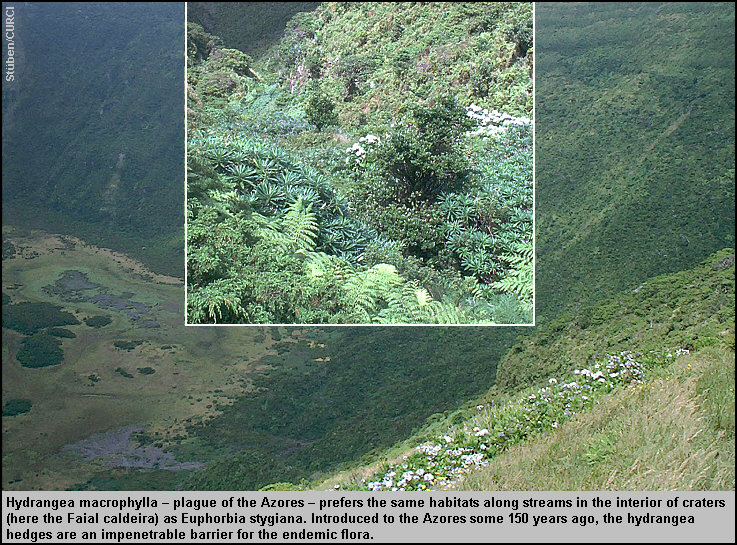
Unfortunately, I found that the hydrangeas – which the tourists love and are
viewed as a plague by those seeking to protect the endemic environment – have
found their way along streams in the interior of the caldeira [Fig.
DR25]. These Hydrangeaceae from Japan occupy the same habitats along
the streams as Euphorbia stygiana,
which cannot compete with it.
…and promotion of active environmental policies on
the Azores
This report on the rediscovery of Acalles
droueti on the Azorean islands of Pico and Faial should end here. But I
would be negligent as an entomologist, and even more so as a taxonomist, if –
in my enthusiasm about finding a species long thought to be extinct – I did
not reflect on the further survival of this unique Cryptorhynchinae (there is
considerable discussion at the CURCULIO Institute about which genus it should
belong to). What would be the sense of such an excursion, what would be the
value of the new description of this species, if it was not accompanied by
criticism of the lack of environmental protection on the Azores?
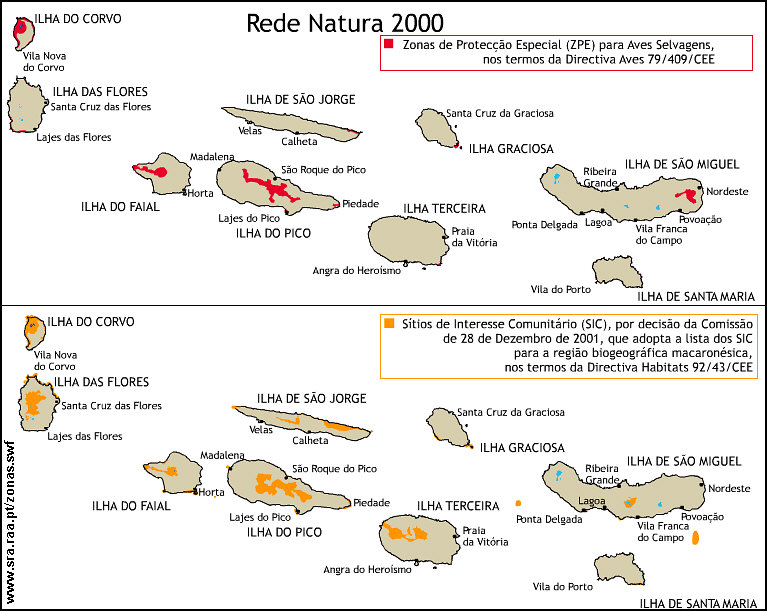
The
NATURA 2000 project [Fig.
DR31] and the preservation of endemic flora
and fauna on the Azores has been discussed in numerous governmental publications
at the EU and national levels. [Fig.
DR31a] These environmental protection
policies are surely necessary if we will be able to hand on the remaining
autochthonous flora and fauna to the next generation. But I have my doubts that
the "philosophy of conservation" and "conservation management
schemes" behind these policies will be effective enough. The areas worthy
of being preserved on the nine islands of the Azores – except for the Faial
caldeira – generally consist of only a few hectares, are not part of any
network of habitats [Borges
et al.: in print], and therefore for many arthropods
(but not birds) are tiny enclaves in a sea of uniform pastures and tree
plantations. In view of this fragmentation and the fact that there is a
threshold below which a micropopulation cannot survive, it must be allowed to
question whether policies limited to protection and conservation are sufficient.
The question must be allowed whether it is not better to undertake an active
policy, for example, to rejuvenate the destroyed flora in the
craters: to not only remove foreign flora from the nature reserves, but
reintroduce the endemic flora, which is well known to have been there originally
– to return to the Azores what we have taken from them over the last several
centuries and decades.
For
me, it is (also) important to save the species Acalles
droueti Crotch 1867 from extinction. It
is one thing to provide professors and students on the Azores with the funds
need to study the microecological requirements of the species along a
well-selected transect. This is absolutely necessary for serious scientific
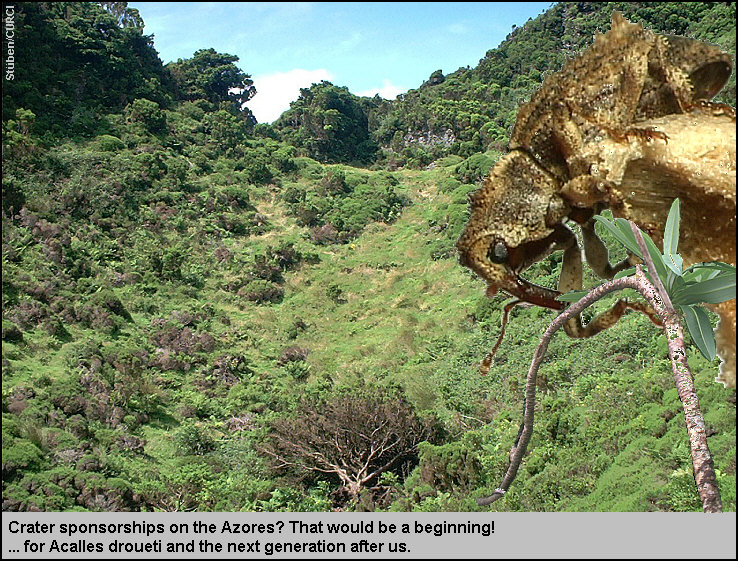
work. But it is just as important to apply this knowledge. Why not begin
with the reforestation of the many small, damaged craters on Terceira, Pico, and
the other islands, with the reintroduction of endemic flora. For example,
students could carry out such work, and politicians and others could sponsor
individual craters. That would be a beginning. But – in contrast to most parts
of continental Europe or on the other Portuguese islands in the Atlantic – is
there any other alternative in the "green deserts" of the Azores?! [Fig.
DR26]
*
The scientific results, description, and redescription of new Cryptorhynchinae,
the description of larva and pupa, as well as raising the next generation – if
successful – of Acalles droueti, will be presented in SNUDEBILLER
5/2004.
Appendix 1
The data on the findings
of Acalles droueti Crotch 1867 during
my excursion to the Azores [Fig. DR34]
All
new records based on [Borges 1990: Table II.]
Portugal,
Azores: Pico, near "EN3" (Transversale), 841 m, N38°29'15"
W28°20'47", Euphorbia stygiana,
18.8.2003, 41 specimens, leg. Stüben,
det. Stüben, coll. Stüben, Bahr.
Portugal,
Azores: Pico, near "EN3 x EN2", 751 m, N38°28'34" W28°17'49",
18.8.2003, Euphorbia stygiana, 22
specimens, leg. Stüben,
det. Stüben, coll. Stüben.
Portugal,
Azores: Pico, Pico da Urze, 811 m, N38°27'21" W28°21'04",
19.8.2003, Euphorbia stygiana, 88
specimens, leg. Stüben,
det. Stüben, coll. Stüben, Bahr, Borges
Portugal,
Azores: Pico, near Cabeco da Rochinho, 5 km NW Calheta, crater, 640 m, N38°25'36"
W28°07'53", 19.8.2003, Euphorbia
stygiana, 5 specimens, leg. Stüben, det. Stüben, coll. Stüben.
Portugal,
Azores: Faial, Caldeira, "Res. Natural
da Caldeira do Faial", 841 m, N38°34'55" W28°42'24",
23.8.2003, Euphorbia stygiana, 5
specimens, leg. Stüben,
det. Stüben, coll. Stüben.
Portugal,
Azores: Faial: Caldeira, "Res. Natural
da Caldeira do Faial", 886 m, N38°35'10" W28°42'04",
24.8.2003, Euphorbia stygiana, 25
specimens, leg. Stüben,
det. Stüben, coll. Stüben, Borges.
After
completion of this report, I received two further specimens from my colleague
Paulo Borges (Azores: Terceira), belonging unambiguously to Acalles
droueti Crotch 1867.
It should be noted that Isabel Amorim and F. Pereira, a student and a technician
of P. Borges, collected in 2001 altogether 12 specimens of Acalles
droueti at Cabecinhos (Pico) when sampling Tarphius spec. on Euphorbia
stygiana, being the specimens only recently rediscovered among stored
samples when F. Pereira saw a picture of the species sent to P. Borges by me.
Portugal,
Azores: Pico, Cabecinhos, 710 m, Euphorbia stygiana, 14.8.2001, 2
specimens, leg. Amorim & Pereira, det. Stüben, coll Borges.
New
records for Pico and Faial!
Appendix 2
The data on the findings
of Curculionoidea specimens during my excursion to the Azores (identified by
Lutz Behne of Eberswalde, DEI (German Entomological Institute), Germany)
All
new records based on [Borges 1990: Table II.]
Aspidapion
radiolus chalybeipenne
(Wollaston 1854)
Portugal,
Azores: Terceira, Biscoitos (near coast), 5 m, N38°48'02" W27°15'00",
6.8.2003, Malvaceae, 5 specimens,
leg. Stüben, det. Behne,
coll. Stüben, Behne, Borges.
Caenopsis
waltoni
(Boheman 1843) [Fig.
DR32]
Portugal,
Azores: Pico, SE S. Roque do Pico, "Misterio da Prainha", 180 m,
N38°28'28" W28°13'10", 15.8.2003, Pittosporum/Pinus-Forest
(sifted), 2 specimens, leg. Stüben,
det. Behne, coll. Stüben,
Behne.
New
record for the Azores (from Madeira or Western Europe)!
Cathormiocerus
curvipes
(Wollaston 1854)
Portugal,
Azores: Flores, E Ponta Ruiva, "Faya da Ponta Ruiva", 250 m,
N39°29'41" W31°09'15", 9.8.2003, Pittosporum undulatum (sifted), 1 specimen, leg. Stüben,
det. Behne, coll. Stüben.
Portugal,
Azores: Flores, Santa Cruz das Flores, coast (sifted), ca. 30 m, N39°27'31"
W31°07'40", 10.8.2003, 1
specimen, leg. Stüben, det. Behne, coll. Behne.
Portugal,
Azores: Terceira, Angra do Heroismo, "Monte Brasil", on a wall, 50
m, 5.8.2003, 1 specimen, leg. Stüben,
det. Behne, coll. Stüben.
New
record for Terceira!
Gymnetron
pascuorum
(Gyllenhal 1813)
Portugal,
Azores: Terceira, 2 km NE San Bartolomeu, 159 m, N38°40'51" W27°15'59",
2.8.2003, (Castanea sativa), 1
specimen, leg. Stüben,
det. Behne, coll. Stüben
New
record for Terceira!
Naupactus
peregrinus
(Buchanan 1939)
(=
Graphognathus)
Portugal,
Azores: Flores, Santa Cruz das Flores, coast (on wall), ca. 30 m, N39°27'31"
W31°07'40", 10.8.2003, 1
specimen, leg. Stüben,
det. Behne, coll. Behne.
Otiorhynchus
cribricollis
Gyllenhal 1834
(=
O. trophonius var. azoricus
Uyttb. 1940)
Portugal,
Azores: Faial, near Ribeirinha, 123 m, N38°35'48" W28°36'57",
21.8.2003, Pittosporum, Fagus
(sifted), 2 specimens, leg. Stüben,
det. Behne, coll. Stüben.
Portugal,
Azores: Flores, N Faja Grande, "Ponta", coast, ca. 100 m, N39°28'41"
W31°15'29", 11.8.2003, Picconia
azorica (sifted), 9
specimens, leg. Stüben, det. Behne, coll. Stüben, Behne, Borges.
Portugal,
Azores: Flores, Santa Cruz das Flores, coast, ca. 30 m, N39°27'31" W31°07'40",
10.8.2003, Rhaphiolepis umbellata
(sifted), 1 specimen, leg. Stüben,
det. Behne, coll. Stüben.
Portugal,
Azores: Flores, in the vicinity of Ponta Delgada, 148 m (sifted), N39°30'44"
W31°13'40", 8.8.2003, 1
specimen, leg. Stüben,
det. Behne, coll. Stüben.
New
record for Flores!
Portugal,
Azores: S.Miguel, near Feteiras, beach, 4 m, N37°43'34" W25°20'25",
31.8.2003, 1 specimen, leg. Stüben, det. Behne, coll. Stüben.
Portugal,
Azores: Terceira, near Quatro Ribeiras (coast), 24 m, N38°47'31" W27°13'29",
6.8.2003, Azorina vidalii, 1
specimen, leg. Stüben,
det. Behne, coll. Stüben.
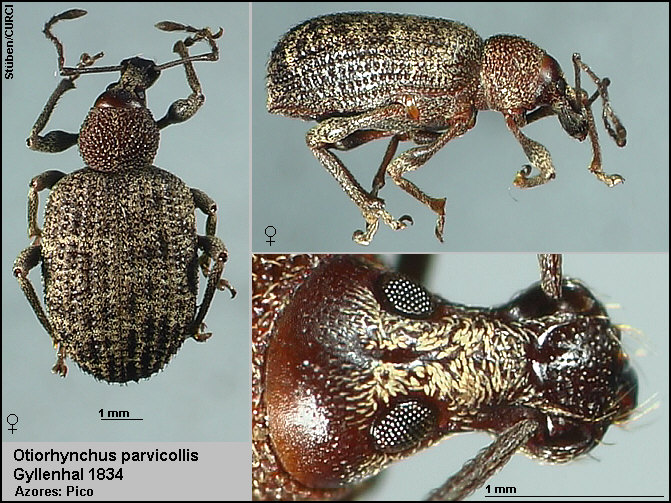
Otiorhynchus
parvicollis
Gyllenhal 1834 [Fig.
DR33]
Portugal,
Azores: Pico, N Silveira, 206 m, N38°25'26" W28°16'43", Pittosporum
undulatum (on a dead branch), 1
specimen, 16.8.2003, leg. Stüben,
det. Behne, coll. Stüben.
New
record for the Azores (from Portugal or North Africa)!
Otiorhynchus
sulcatus
(Fabricius 1775)
Portugal,
Azores: Faial, near Ribeirinha, 123 m, N38°35'48" W28°36'57",
21.8.2003, Pittosporum, Fagus
(sifted), 2 specimens, leg. Stüben,
det. Behne, coll. Stüben, Behne.
Portugal,
Azores: Pico, S Santa Luzia, 224 m, N38°31'56" W28°24'25",
17.8.2003, Pittosporum undulatum, 1
specimen, leg. Stüben, det. Behne, coll. Stüben.
Pantomorus
cervinus
(Boheman 1849)
(=
Asynonychus godmanni (Crotch 1867),
godmani auct. err.)
Portugal,
Azores: Flores, Santa Cruz das Flores, coast (on a wall), ca. 30 m, N39°27'31"
W31°07'40", 10.8.2003, 2
specimens, leg. Stüben, det. Behne, coll. Stüben.
Portugal,
Azores: Flores, near Ponta Delgada, 148 m, N39°30'44" W31°13'40",
8.8.2003, 7 specimens, leg. Stüben,
det. Behne, coll. Stüben, Behne, Borges.
Portugal,
Azores: Pico, SE S. Roque do Pico, "Misterio da Prainha", 180 m,
N38°28'28" W28°13'10", 15.8.2003, way near Pittosporum/Pinus-Forest,
2 specimens, leg. Stüben, det. Behne, coll. Stüben.
Pselactus
spadix
(Herbst 1795)
Portugal,
Azores: Terceira, Biscoitos (near coast), 5 m, N38°48'02" W27°15'00",
6.8.2003, Crithmum maritimum, 3
specimens, leg. Stüben, det. Behne, coll. Stüben, Behne.
New
record for Terceira!
Pseudechinosoma
nodosum
Hustache 1936
Portugal,
Azores: Flores, N Faja Grande, "Ponta", coast, ca. 100 m, N39°28'41"
W31°15'29", 11.8.2003, Picconia
azorica (sifted), 9
specimens, leg. Stüben,
det. Behne, coll. Stüben, Behne, Borges
Endemic
Pseudophloeophagus
aeneopiceus
(Boheman 1845)
Portugal,
Azores: Faial, near Ribeirinha, 123 m, N38°35'48" W28°36'57",
21.8.2003, Pittosporum, Fagus
(sifted), 1 specimen, leg. Stüben, det. Behne, coll. Stüben.
Portugal,
Azores: Flores, near Ponta Delgada, 148 m (sifted), N39°30'44" W31°13'40",
8.8.2003, 2 specimens, leg. Stüben, det. Behne, coll. Stüben,
Behne.
Portugal,
Azores:Terceira, Terra Brava, "Laurisilva", 640 m, N38°44'16"
W27°12'05", 3.8.2003, 3
specimens, leg. Stüben,
det. Behne, coll. Stüben, Behne.
Portugal,
Azores: Terceira, near Quatro Ribeiras (coast), 24 m, N38°47'31" W27°13'29",
6.8.2003, Azorina vidalii, 4
specimens, leg. Stüben, det. Behne, coll. Stüben, Behne, Borges
Pseudophloeophagus
tenax
(Wollaston 1854)
Portugal,
Azores: Faial: Caldeira, "Res. Natural
da Caldeira do Faial", 886 m, N38°35'10" W28°42'04",
24.8.2003, Euphorbia stygiana, 1
specimen, leg. Stüben,
det. Stüben, coll. Stüben.
Portugal,
Azores: Flores, N Faja Grande, "Ponta", coast, ca. 100 m, N39°28'41"
W31°15'29", Picconia azorica
(sifted), 1 specimen, 11.8.2003,
leg. Stüben, det. Behne, coll. Stüben.
Portugal,
Azores: Pico, N Silveira, 206 m, N38°25'26" W28°16'43", Pittosporum
undulatum (in a dead branch), 2
specimens, 16.8.2003, leg. Stüben, det. Behne, coll. Stüben.
Portugal,
Azores: Terceira ,4 km NE San Bartolomeu, "Matela", 350 m, N38°41'49"
W27°15'54", 2.8.2003, Laurus
azorica, 5 specimens, leg. Stüben,
det. Behne, coll. Stüben, Behne, Borges
Portugal,
Azores:Terceira, Terra Brava, "Laurisilva", 640 m, N38°44'16"
W27°12'05", 3.8.2003, 2
specimens, leg. Stüben,
det. Behne, coll. Stüben.
Rhopalomesites
tardyi
(Curtis 1825)
Portugal,
Azores: Flores, N Faja Grande, "Ponta", coast, ca. 100 m, N39°28'41"
W31°15'29", 11.8.2003, Picconia
azorica (sifted), 4
specimens, leg. Stüben,
det. Behne, coll. Stüben, Behne, Borges
Portugal,
Azores: Flores, SW Ponta Delgada, 489 m, N39°29'28" W31°11'58",
9.8.2003, ex Euphorbia stygiana, 3
specimens, leg. Stüben, det. Behne, coll. Stüben, Behne.
Portugal,
Azores: Terceira ,4 km NE San
Bartolomeu, "Matela", 350 m, N38°41'49" W27°15'54",
2.8.2003, Laurus azorica, 1
specimen, leg. Stüben, det. Behne, coll. Stüben.
New
record for Terceira!
Sitona
puberulus
Reitter 1903
Portugal,
Azores: Faial, near Ribeirinha, 123 m, N38°35'48" W28°36'57",
21.8.2003, on wall, 1 specimen, leg. Stüben,
det. Behne, coll. Stüben.
Portugal,
Azores: Flores, Santa Cruz das Flores, coast (on wall), ca. 30 m, N39°27'31"
W31°07'40", 10.8.2003, 2
specimens, leg. Stüben, det. Behne, coll. Stüben, Behne.
Tychius
cuprifer
(Panzer 1799)
Portugal,
Azores: San Miguel, Achada (coast), 137 m, N37°51'17" W25°16'17",
27.8.2003, 1 specimen, leg. Stüben,
det. Behne, coll. Stüben.
References
Borges
P.A.V. (1990): A
checklist of Coleoptera from the Azores with some systematic and biogeographic
comments. – Boletim do Museu Municipal do Funchal, 42
(220): 87-136.
Borges,
P.A.V., Aguiar, C., Amaral, J., Amorim, I.R., André, G., Arraiol, A., Baz, A.,
Dinis, F., Enghoff, H., Gaspar, C.,
Ilharco, F., Mahnert, V., Melo, C., Pereira, F., Quartau, J.A., Ribeiro, S.,
Ribes, J., Serrano, A.R.M., Sousa, A.B., Strassen, R.zur, Vieira, L., Vieira,
V., Vitorino, A., & Wunderlich, J. (in print):
Ranking
protected areas in the Azores using standardized sampling of soil epigean
arthropods. Biodiversity and Conservation
Israelson
G. (1990): Further
notes on the Coleopterous fauna of the Azores, with speculations on its origin.
– Bocagiana (Madeira),138: 1-8.
Schäfer
H. (2002): Flora
of the Azores. A field Guide, Weikersheim, 264 pp.
Sprick
P. & Stüben, P.E. (2000):
Ökologie der kanarischen Cryptorhynchinae außerhalb des Laurisilva. - in: Stüben,
P.E. (2000b), SNUDEBILLER 1 (CD ROM):
318-341, Mönchengladbach.
Stüben
P.E. (2000e):
Die Arten des Genus Acalles von den
Kanarischen Inseln. - in: Stüben, P.E. (2000b), SNUDEBILLER 1
(CD ROM): 22-98, Mönchengladbach.
Stüben
P.E. (2000k):
Phylogenie der endemischen Taxa des Genus Acalles
von den Kanarischen Inseln. - in: Stüben, P.E. (2000b), SNUDEBILLER 1 (CD ROM): 287-292, Mönchengladbach.
Stüben
P.E. (2002):
Die Cryptorhynchinae von den Inseln
Madeiras und Salvagens. Taxonomie, Bionomie, Biogeographie und Evolution.
(Coleoptera: Curculionidae). - SNUDEBILLER 3,
Studies on taxonomy, biology and ecology of Curculionoidea, Mönchengladbach:
CURCULIO-Institute, 88-195.
Stüben
P.E. (2003b):
Breeding of Kyklioacalles euphorbiophilus Stüben 2003 (Coleoptera:
Curculionidae: Cryptorhynchinae) - Weevil
News: http://www.curci.de/Inhalt.html, No. 15, CURCULIO-Institute: Mönchengladbach:
6 pp.
Stüben
P.E., Behne, L. & Bahr, F. (2003): Analytischer
Katalog der westpaläarktischen Cryptorhynchinae / Analytical Catalogue of
Westpalearctic Cryptorhynchinae. Teil/Part 2:
Acalles, Acallocrates (Col.: Curculionidae: Cryptorhynchinae). - SNUDEBILLER
4, Studies on taxonomy, biology and ecology of Curculionoidea, Mönchengladbach:
CURCULIO-Institute.
Sjögren
E. (2001):
Plants and Flowers of the Azores, Azores: Lajes do Pico, 191 pp.
Address:
Dr.
Peter E. Stüben
CURCULIO Institute
Hauweg
62, D- 41066 Mönchengladbach, Germany
E-Mail:
P.Stueben@t-online.de